Heat Curve
Definition
On a heating appliance, a heat curve (or heating curve) describes the relationship between the outside temperature and the flow temperature of the heating system. In simpler terms, the colder it is outside, the hotter the water in the system needs to be, to keep the inside temperature comfortable. This means that as the outside temperature drops, the heating system will increase the temperature of the water it sends to your radiators or underfloor heating to compensate. Conversely, when it's warmer outside, the water temperature is reduced to avoid overheating your home.
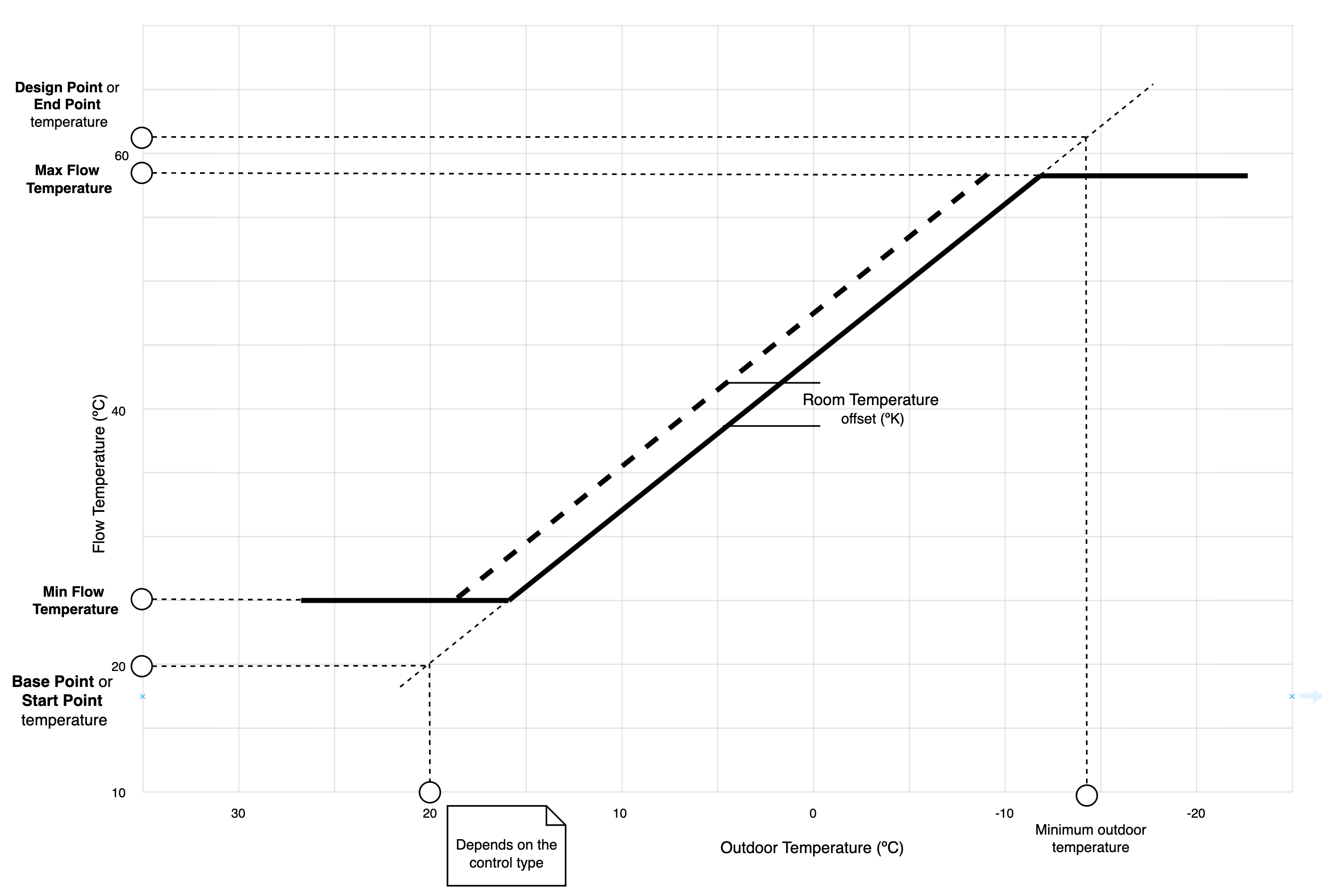
Following the image as an example:
- The X-axis represents the outside temperature, with warmer temperatures on the left and colder temperatures on the right.
- The Y-axis represents the flow temperature of the water in the heating system, getting hotter as you move upwards.
- The curve itself shows the relationship between these two. As the outside temperature drops (moving to the right on the X-axis), the flow temperature increases to maintain a comfortable indoor temperature.
- Maximum Flow Temperature: Usually around 60-70°C. This is the highest temperature the water in the heating system will reach, typically when the outside temperature is at its coldest point defined by the heat curve. Going beyond this can lead to inefficiencies and safety concerns.
- Minimum Flow Temperature: This can vary but is often around 20-30°C. This is the lowest temperature that the water will be heated to, typically when the outside temperature is mild and minimal heating is required.
- Start Point or Base Point: This is the start point temperature of the heat curve for the heating system. It indicates the flow temperature at the highest outside temperature, which is based on the control unit type. This theoretical value, along with the end point temperature, determines the slope of the heat curve but does not affect the minimum temperature. The minimum and maximum values depend on the appliance configuration.
- End Point or Design Point: This is the end point temperature of the heat curve for the heating system. It indicates the flow temperature at the lowest outside temperature. This theoretical value, along with the start point temperature, determines the slope of the heat curve but does not affect the maximum temperature. The minimum and maximum value of the end point temperature depend on the appliance configuration.
- Room Offset Temperature: This is the difference between the desired room temperature and the flow temperature required to achieve it.
- Room Influence Temperature: This is the current room influence temperature for the heating circuit. This value is used as a "feedback loop" for the heating system, to adjust the current flow temperature based on the room temperature. The minimum and maximum value depend on the appliance configuration.
- Control Type: The control type defines how the heating system is run (see
Control Typetable).
| Control Type | Outside Temperature (from) | Outside Temperature (to) |
|---|---|---|
| Weather-Compensated | 20ºC | -20ºC |
| Weather-Compensated Simplified | 30ºC | -20ºC |
Control Types
Weather-Compensated Optimized
Also called outside temperature-compensated, is an upward-shaped heating curve based on an optimized allocation of the flow temperature according to the outside temperature. Only the desired temperature and maximum temperature must be set. This variant is set as default and fits for common use cases.
Weather-Compensated Simplified
When the heat curve is calculated based on the outdoor temperature with a base point. The outside temperature with base point is a classic heating curve setting that provides multiple options to comply with individual building requirements. This heating curve has a base point and an end point.
Intelligent Single Room Control
When the control type of the heating circuit is set to ISRC, the heat curve is not used. Instead, the system relies on room temperature sensors to
determine the heating needs of individual rooms. The flow temperature is adjusted based on the actual room temperatures rather than the outside temperature.
Notes:
On
Weather-Compensatedcontrol type, the Starting Point is fixed (X=20ºC and Y=20ºC).It is possible to get and update the heat curve via Partner Web API using GET Heat Curve and PATCH Heat Curve endpoints found in the api reference.